
Posted by HOT LAPS HOBBY SHOP on Jun 24th 2026
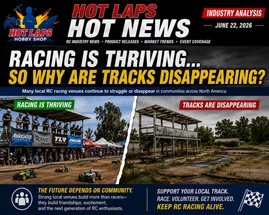
RACING IS THRIVING... SO WHY ARE TRACKS DISAPPEARING?
Walk through any hobby shop today and you'll find no shortage of race-inspired RC vehicles. Manufacturers continue introducing new competition buggies, touring cars, dirt oval machines, and vintage racing reissues. Major events still attract hundreds of entries, and social media is filled with race coverage from around the world.
By many measures, RC racing appears healthy.
Yet across North America, a different story is unfolding at the local level.
Tracks continue to struggle. Some have reduced schedules. Others have changed ownership. A few have disappeared entirely.
One of the most notable examples was Southern California's Thunder Alley RC Raceway. In October 2024, the iconic facility announced it would permanently close at the end of the year, citing circumstances largely beyond its control and plans by the park district to repurpose the property. For many racers, the news was a shock. Thunder Alley had hosted major national events and was considered one of the most recognizable off-road tracks in the country.
Fortunately, Thunder Alley's story ultimately took a positive turn. Following significant support from the RC community, the facility was preserved and reopened under new leadership as The Drake Raceway. The rescue demonstrated what can happen when a community rallies behind a racing venue.
Unfortunately, not every facility receives a second chance.
The challenge facing RC racing venues is not necessarily a lack of interest in RC cars. Instead, track operators often find themselves squeezed by rising land values, increasing operating costs, insurance expenses, maintenance requirements, and the ongoing challenge of attracting enough regular participants to sustain operations. Many venues rely heavily on volunteers and a small group of dedicated racers to keep events running week after week.
The hobby itself has also changed.
Thirty years ago, organized racing was often the primary destination for RC enthusiasts. Today, hobbyists can choose from drifting, crawling, Mini-Z racing, scale construction equipment, boating, aircraft, backyard bashing, and countless other segments. The RC world has become larger and more diverse, but that diversity means local race programs must compete for participants' time and attention.
This raises an important question:
If the hobby is still producing exciting new vehicles and attracting enthusiastic participants, what makes certain venues successful while others struggle?
The answer may be community.
The tracks that survive often become much more than a place to race. They become gathering places where newcomers learn, experienced racers mentor others, families spend time together, and friendships are built. In many cases, racers return not only for the competition, but for the people.
Perhaps the lesson isn't that RC racing is disappearing.
Perhaps the lesson is that facilities built around community are becoming more important than ever.
Cars can be ordered online.
A racing community cannot.
As the RC hobby moves forward, the long-term health of organized racing may depend less on the next great vehicle release and more on preserving the places where enthusiasts gather to enjoy them.