Posted by HOT LAPS HOBBY SHOP on Jul 12th 2026
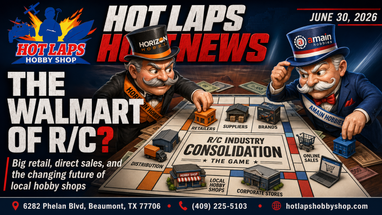
THE WALMART OF R/C?
HOT LAPS HOT NEWS
June 30, 2026
THE WALMART OF R/C?
Big retail, direct sales, and the changing future of local hobby shops
The RC hobby has always had big brands, strong distributors, and passionate local shops.
But the business behind the hobby is changing.
For years, the traditional hobby shop model was fairly easy to understand. Manufacturers made the products. Distributors supplied the products. Local hobby shops stocked the shelves, answered questions, supported customers, hosted events, fixed problems, and helped build the community.
That model still exists.
But it is not as simple as it used to be.
Today, some of the largest players in RC are no longer just manufacturers, distributors, or retailers. They are becoming combinations of all three.
That raises an important question:
What happens when your supplier also becomes your competitor?
AMain Hobbies has grown from a major online RC retailer into a much larger force in the hobby business. Its acquisition of HobbyTown corporate added a major brick-and-mortar franchise system, additional distribution infrastructure, and a much larger national retail footprint. HobbyTown has also begun opening corporate-owned locations, including a store in Spring, Texas.
That matters.
A corporate store is different from a locally owned independent hobby shop. It is also different from a franchise store owned by a local operator. A corporate-owned retail location means the larger company is now operating directly in the same physical retail space where local hobby shops already compete.
At the same time, Horizon Hobby has followed its own path of consolidation over the years, acquiring or controlling major RC brands, product lines, and retail assets. Horizon’s growth has included well-known names across vehicles, parts, accessories, bodies, electronics, and online retail.
So the industry is changing from both directions.
One side controls more of what gets made.
The other side controls more of how products are sold, distributed, fulfilled, and placed in front of customers.
That does not automatically make either company bad.
Large companies can bring real benefits to the hobby. Better logistics can mean better product availability. Larger distribution networks can mean faster shipping. Bigger marketing budgets can expose more people to RC. Stronger online systems can make ordering easier. National brands can help keep products visible and accessible.
Those are real advantages.
But there is another side to the story.
For independent hobby shops, the relationship can get complicated fast.
A local shop may rely on a supplier for inventory, parts, electronics, kits, tires, tools, and accessories. That same supplier may also sell directly to customers online. It may offer loyalty rewards, discount pricing, free shipping promotions, national advertising, or corporate-owned retail stores.
In other words, the local shop may buy from a company in the morning and compete against that same company by the afternoon.
That is a very different business environment than the one many hobby shops were built around.
And it matters because local hobby shops do things that warehouses, websites, and national chains cannot easily replace.
A good local hobby shop helps a beginner choose the right vehicle instead of the flashiest one.
It explains batteries, chargers, connectors, tires, gearing, radios, servos, setup, maintenance, and repairs.
It helps people avoid expensive mistakes.
It stocks the emergency part that saves race night.
It gives racers a place to meet.
It supports tracks, events, clubs, drift nights, Mini-Z programs, crawler courses, build nights, and community gatherings.
It gives the hobby a physical home.
That is the part people do not always see when comparing prices online.
The question is not whether big companies should exist. They already do, and they are part of the hobby now.
The better question is:
How does the local hobby shop survive and stay valuable in an industry where the supply chain, the online store, the distributor, and the retail competitor may all be connected?
The answer probably is not trying to beat the biggest companies at their own game.
A local shop cannot always out-warehouse a warehouse.
It cannot always out-discount a national online retailer.
It cannot always out-advertise a corporation.
But it can do something those companies struggle to do at the same level.
It can know its customers.
It can build a local racing scene.
It can help a parent choose the right first RC car for their kid.
It can diagnose a problem at the counter.
It can create a place where people actually gather.
It can support the hobby after the sale.
It can turn a product into an experience.
That may be the real future of the independent hobby shop.
Not just selling boxes.
Building community.
As RC retail becomes more consolidated, local hobby shops will have to prove their value in ways that go beyond price. Service, knowledge, repairs, events, tracks, parts support, and trust may become more important than ever.
The RC industry may be getting bigger.
But the heart of the hobby is still local.
Question of the Day
When you choose where to spend your RC money, what matters most?
Lowest price, fastest shipping, expert advice, local parts support, events, repairs, community, or all of the above?
Sources: AMain Hobbies, HobbyTown, Horizon Hobby.